Archive for japanese

My Favourite New Skirt
July 19th, 2011 | Link

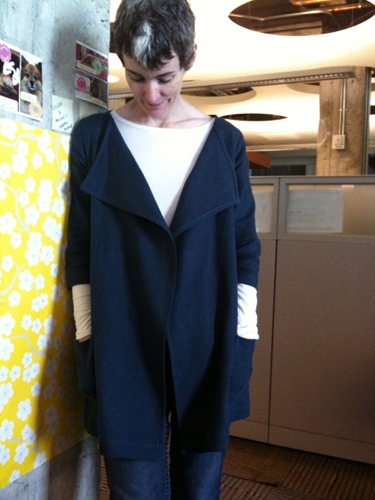
Posing in front of cubicles, wearing a blue-grey skirt, grey knee socks, black cowl-neck top, black cardigan.

More bad iPhone photos. It’s not really the phone, I suspect; more likely the fluorescent overhead lighting, the industrial carpet, and cubicles. Though, check out the lovely exposed brick in our historic landmark building. (And the windows open, which is awesome, and if you look out the window you can see the San Francisco Bay. Pretty nice, all in all.)

Since it’s hard to see above, here’s a close up of the front of the skirt:

Close up of skirt front, showing three front seams with black top-stitching and the lower edge of the covered fly zip.

It’s an eight panel skirt from this Japanese pattern book. The panels taper in at the top for waist shaping. There’s a front fly zip, which I totally botched, but since it’s covered you can’t see that. There was also a waistband, but the waist was already very high on me so I skipped it and drafted a facing instead. My new technique learned on this skirt was French seams, which is how I finished all the panel seams. They look very nice on the inside too! There are also small patch pockets high on the back, that are just big enough for my id badge and some cash.

The fabric is an amazingly soft brushed twill that I’m sure I bought very cheaply at Discount Fabrics. It sat in my stash for a very long time while I tried to get up the courage to try this skirt. There are a lot of pieces, and the instructions for the fly were a bit confusing — at first I thought it was just because it was in Japanese, but then I looked around for other instructions on doing a fly zip, and they were equally confusing.

I notice I seem to be developing a uniform for work: black top, black or grey knee socks or tights, cardigan (usually also black) and then the skirt, which can be playful/casual like the mod skirt or this one, or more classic. This is a step up over my previous work uniform of black t-shirt, jeans, and a hoodie.

Baby Put Your Best Dress On
June 25th, 2011 | Link

Me posing in a red linen sleeveless dress in front of a stand of bamboo.

I told you it would be a surprise!

This is the cover dress from Machiko Kayaki’s Simple Chic, which was one of the first Japanese sewing books I ever bought. I love the book because the dresses are all lined and nicely finished. That said, I ended up not lining this one — I just went with the facings.

Another pose, demonstrating how flared the skirt is.

The big thing I learned on this dress was how to properly hem a very curved hem. Every skirt I’ve done has had minimal flare, so I’ve never had to baste and gather the hem. It turned out to be very easy, but there was a lot of blind-stitching to do. I think the hem was easily double that of any other thing I’ve sewn.

Back view of the dress


At this point I feel like I’ve really got the hang of  invisible zipper installations.

Super happy with this dress. I can tell from the photos I have some mild fit problems, but I feel like I’m getting to the point where I can sew things that are more complex and get decent results.

More Japanese Sewing: Wrap Skirt and T-Shirt
July 11th, 2010 | Link
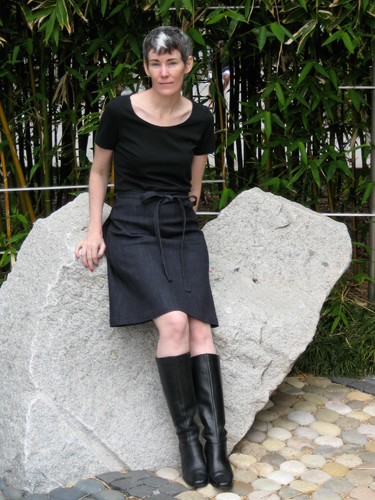
Posing on a rock in front of a bunch of bamboo

One thing I love about the morning fog: it diffuses light wonderfully for photography. And it usually burns off by noon.

I’ve been searching for the perfect -shirt pattern and thought I had it with my tweaked version of Jalie 2805, but this basic t-shirt from Overlock Sewing Everyday Clothes might beat it out as my favorite. Like the Jalie pattern, this one comes with several variations on the sleeves and neck, and the book includes patterns for several other top and tunic styles, a couple of skirts, camisoles and leggings. (I love everything about the outfit shown on the right in this picture – I even bought a pair of black patent ballet flats to reproduce it, and I have some deep red silk/cotton poplin earmarked for the skirt) The amazing thing is that the tutorials in the book are so clear–even though I don’t understand Japanese–that I learned more from them than the English-language serger book I have!

Front detail showing the tie

The wrap skirt is from One Day Sewing Winter Clothes (2007). This is less than an evening’s work. It took me a while to figure out how to work with the pattern, as there were only two pieces on the pattern sheet: turns out that those two pieces had a center mark that I needed to mirror to get the front skirt and facing. Also, for some reason I spaced on the facing and was convinced it was a waistband, and couldn’t figure out how the top of the skirt pieces were supposed to match up. Doh.
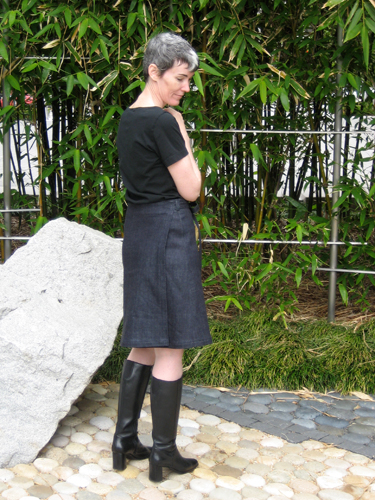
Back view of wrap skirt

This was going to be a muslin from leftover stretch denim, and then I was going to make it up in a lighter weight gray stretch denim that I bought recently from fabric.com. But it turned out well enough that I’m going to save the gray denim for something else. I love this style though, its simplicity and architectural line, and I kind of want to make another one in black, a little shorter, maybe reversible with a crazy print for the other side…
Tokyo Pen Shop, You are my New Best Friend
June 23rd, 2010 | Link

Shiny silver pen and pencil resting on a black Moleskine

I have a bit of a writing tool obsession. In particular, I have an obsession for pens with fine, fine tips, that roll on paper like a marble on glass. I’ve been in love with the Pilot Hi-Tec-C in a 0.4mm tip since I moved to the US, as it was the closest I could find to the Pilot G-Tec pen sold in Canada. The Hi-Tec-C isn’t widely available in the US, but there are a couple of Japanese stationery stores in San Francisco that stock it (Maido in the Westfield Shopping Center, and Kinokuniya Stationery in Japantown). It comes in even in a .3mm and .25mm tip, though I’ve found them too fine for anything but the smoothest papers. It also comes in a bunch of colors, and the blue-black has replaced black as my favorite.

Somewhere, recently, someone pointed me to Tokyo Pen Shop, where they sell the Pilot Hi-Tec-C online – and some mini Hi-Tec-C pens (!) and the very classy, refillable Hi-Tec-C Cavalier (pictured above). This is lovely to hold and is going to be my new favorite pen, even if the refills don’t seem to be available in blue-black.

Also pictured above is the Kuru Toga Pencil, a 0.3mm pencil that is in line to replace the Pentel 120 A3 DX drafting pencil as my favorite.

I placed an order last Friday and it arrived yesterday, so their service is impressive too.

Fugly Pants and Circus Pants: A Cautionary Tale of Online Fabric Shopping
May 5th, 2010 | Link

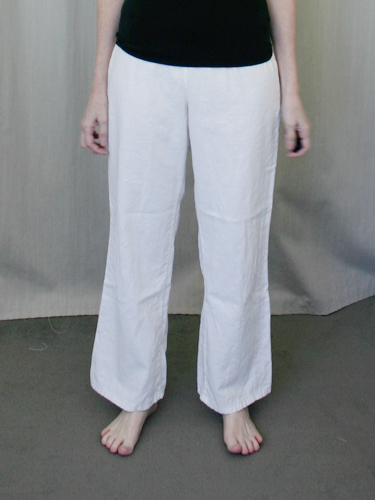
White linen pants

Once upon a time I found some white handkerchief linen at Discount Fabrics, and I thought it would be perfect for a pair of drawstring pants I wanted to make from one of my Japanese sewing books (One Day Winter Sewing, 2008). So I bought it, and I made them, and they turned out pretty well and they’re super comfortable, but of course white handkerchief linen is kind of sheer, and the resulting pants can’t really be worn outside the house in sunlight without violating decency laws (even in San Francisco). So the white pants became pajama pants, and I went looking for some different fabric to remake them from.

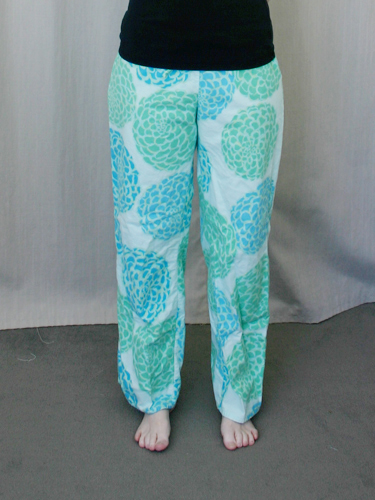
Fabric.com was having a flannel sale and a seersucker sale, so I thought I would pick up some flannel and make a pair of cool weather pajama pants, and some seersucker for summer. And herein lies my cautionary tale. I saw a cheerful and cute flannel that looked like little chrysanthemums on an aqua background, so I bought it–neglecting to first check the scale of the photograph and the actual size of the flower motifs. So when I received the fabric, I discovered that those cute quarter-sized-looking flowers were actually huge:

Flannel pants with huge floral pattern

I like to call these “fugly pants” because they in no way match my style, and between the size of the flowers and the rigidity of the flannel they look huge. Ugh. But they are comfortable, and even though E. winces every time I put them on I have been wearing them to sleep in.

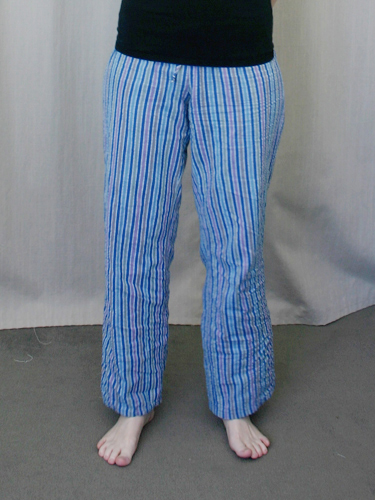
The seersucker was another story. The scale is what I expected from the photo, but the colors are brighter, and with the striped pattern… well, I call these “circus pants”:

Brightly striped seersucker pants

The seersucker is cool but not quite as comfortable as I would have thought – the puckers are kind of stiff and scratchy. I’m hopeful that a few washes will take care of that, and take some of the stiffness out of the flannel.

So I now have several pairs of pajama pants, but still nothing I’d want to wear outside the house. But I have some black linen/rayon blend fabric with some textural interest that has lovely drape, doesn’t wrinkle as badly as the pure handkerchief linen, is cool and light, and is neither sheer nor fugly. So I might be revisiting this pattern one more time. On the bright side it takes very little time to put these together–there are just two front pieces and two back pieces; the waistband is folded over and has buttonholes for the drawstring. On the other hand, maybe I should use the linen/rayon blend for a pattern with a bit more shaping…

Habu Kit 78 (Kusha Kusha Scarf)
May 2nd, 2010 | Link

Scarf pic

In the interests of (trying) not acquiring new stash until I’ve used up what I already have, and also being crazy busy and so doing the smaller, simpler projects first, let me present the Kusha Kusha scarf from Habu. I bought it as a kit from Knit Purl when I was in Portland last September. It’s a simple stockinette pattern, with a few stitch decreases at the beginning and further tapering about two-thirds of the way through that is achieved by gradually decreasing the needle size rather than the number of stitches. The main point of interest is that it’s knit with two lace-weight yarns held together throughout, one stainless steel and one merino wool, and then felted slightly to finish.

The results are (1) interesting texture and waffling along the edges, caused by the wool yarn shrinking during the felting while the stainless steel does not, and (2) if you crunch the resulting fabric into a ball with your hand, the stainless steel yarn holds some memory of the scrunch, so you can get some sculptural texture.

I didn’t fully follow the pattern: after the first transition to smaller needles the instructions say to drop the merino yarn and only continue with the stainless steel. I tried it, but I didn’t like the abrupt change in color (the merino is black, and the stainless steel is about the color you’d expect from stainless steel) and I had a lot of the merino left, so I decided to just keep using both yarns until I ran out.

Japanese Sewing: Happy Homemade 1-J
March 16th, 2010 | Link

Jacket - front view

I’ve been sewing a bit lately and having some good successes and less frequent failures. The bottleneck in blogging is (apparently) getting photographs of the completed items. But here’s this weekend’s success, the popular jacket model J from Happy Homemade Vol. 1 in blue linen.

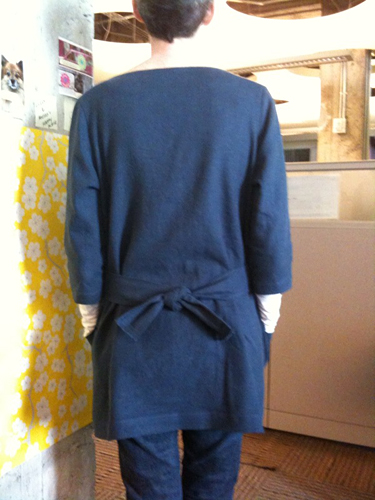
Jacket - back view

This turned out remarkably well, aside from not having quite the same crinkly drape that the pictures in the pattern book had (you can see them in the fourth image on the book link above)–I think they used a linen blend with silk or rayon. I also think mine will drape a bit more when I wash it again (I washed the fabric cold and dried it hot once to shrink it before cutting, but I can tell there’s still quite a bit of sizing in it).

I like it now though. It’s getting a lot of love from my coworkers today too.

PS: the T-shirt is the basic crew-neck from Jalie 2805. I folded it over at the neck and stitched with a twin needle, rather than a sewing on a separate neckband, so it’s not as high as the version on the pattern envelope.

Fun with Japanese Sewing Patterns
February 7th, 2010 | Link

If I can just have a goshdarnit-that-was-smart moment here:

Through Yoshimi the Flying Squirrel, I found the Japanese pattern company anneedeux, which has some nice top patterns and sells them (and other patterns) as downloadable PDF files. With a little help from a Japanese-speaking coworker, I was able to download two of them last week (payment is through PayPal, and everything went quite smoothly once I got through the cart checkout). I was super-excited until I went to print off the PDF files, and realized that (1) Mac Preview software doesn’t read the PDFs properly, they require Adobe Acrobat (it took me two days to figure that out); (2) the pages scaled down slightly, so I had to change the printer settings to not do that; (3) the reason why the pages had scaled down slightly was because–of course–the PDF was A4 size, not US letter size.

So I shrugged and figured I could take the files to a print shop and print them on legal size or something. Slight delay, no big deal. But today E. and I were taking advantage of Superbowl Sunday to go shopping downtown and as we made the rounds of our usual haunts, we stopped at Maido, a Japanese stationery store in the Westfield shopping center, to stock up on Pilot HI-TEC-C 0.4mm blue-black rollerball pens. And it was there that I found the answer to my problem: A4 Kraft paper!

(I had already reached a similar solution this morning in the ‘tub: I could cut some large sheets of card stock down to A4-size sheets on the Kutrimmer and manually feed them through the printer. Except my Kutrimmer is buried under a pile o’ stuff right now, so I left the idea percolating.)

On the way home, I reasoned it was unlikely that electronics companies would make different printers for the US and Canada than they would for the rest of the world, and I was right: the paper tray adjusts to take A4 paper. And the lightweight Kraft paper went through the printer without difficulty. So I was able to print off the pattern sheets and now I’m going to tape them together so I an cut out my patterns. w00t!

Robots Guard My ID
January 7th, 2010 | Link

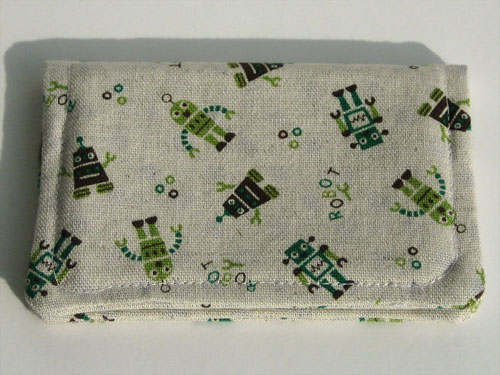
Front view of card wallet: green and brown cartoon robots on linen

I’ve been using a duct tape wallet that Edmond gave me for a couple of years now, and it’s still holding up well but it’s hard to get the cards out sometimes. I decided to make another one for myself.

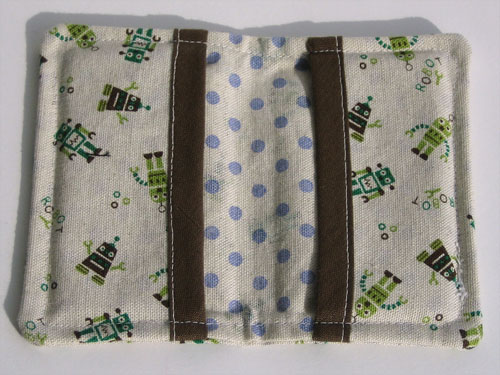
Inside view of card wallet: backing fabric is lavender polka dots

The fabric is a reversible Japanese cotton-linen blend from Superbuzzy: yes, it is reversible; the lavender polka dots you see on the inside are the back side of the robots! How awesome is that? The linen bias tape is also from Superbuzzy.

I used a 1/4″ radius for the corners, and found it difficult to do the stitching/turning/topstitching, so I probably should have used a 1/2″ radius. And it could probably benefit from a snap or some velcro to hold it together, though I haven’t had any problems with it flipping open in my bag.

It was super-quick to make, and I got six of them (with leftovers) out of one half-yard of fabric and one package of bias tape–one for me, and a bunch to give away at Christmas. I lurve it!

Adventures in Sewing from Japanese Patterns
July 3rd, 2009 | Link

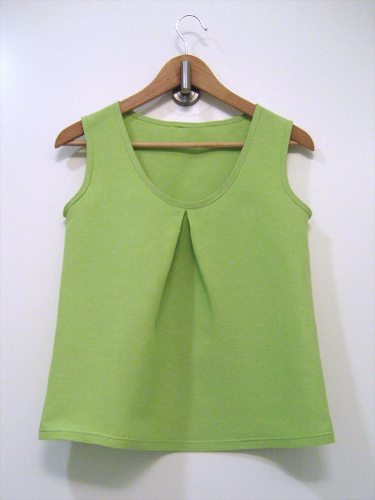
Green linen sleeveless top from Every Day Camisoles and Dresses

Recently I’ve been inspired to try sewing from Japanese pattern books. I purchased some books from Pomadour24′s Craft Café on Etsy and was very happy with the experience—the books arrived from Japan in about a week. There are several stores on Etsy that sell them, and in most cases the sellers have photographed or scanned pages from the books so that you can see what the patterns look like. I’ve also been reading Japan Couture Addicts, a French blog by Japanese sewing fans who post their creations. It’s a little weird to be reading in French about Japanese patterns, and I only get about half of it (I studied French for 10 years at school, but haven’t had much occasion to use it in the 25-odd years since), but it’s interesting to see how the finished garments look on different body types, and to see how people have modified the patterns. A couple of times I’ve dismissed a pattern at first look, then seen how someone else had made it up and fallen in love with it.

If you’ve done basic garment sewing, it’s not hard to follow the patterns. The biggest challenge is usually finding and tracing all the pattern pieces from the giant piece of paper that accompanies the book. Once you’ve traced the pieces, you also have to add in the seam allowances, which I was struggling with a bit—straight lines are easy, but curves were a bit of a pain until I discovered this brilliant tip of using the sewing machine. I also found a lot of useful information from this series on sewing from Japanese craft books and from this list of translations.

Denim box-pleat skirt from Machiko Kayaki's book, Simple Chic

So far I’ve made a couple of summer tops and a skirt (sorry, not the best photo of the skirt—it was really windy that day), and the muslin for a dress that I might sew up with what’s left of this long weekend. There will probably be quite a few more postings on this subject in the weeks to come.

Search

About

My name is Shannon Hale. I make things from paper, cloth and yarn, and sometimes write about other things going on in my life. More...

Previously

2012: 1 2 3 4 5 6 7 8 9 10 11 12

2011: 1 2 3 4 5 6 7 8 9 10 11 12

2010: 1 2 3 4 5 6 7 8 9 10 11 12

2009: 1 2 3 4 5 6 7 8 9 10 11 12

2008: 1 2 3 4 5 6 7 8 9 10 11 12

2007: 1 2 3 4 5 6 7 8 9 10 11 12

2006: 1 2 3 4 5 6 7 8 9 10 11 12

2005: 1 2 3 4 5 6 7 8 9 10 11 12